The ache is centrifugal
deep-rooted in my core,
rotting the whole apple
with just a tiny spore.
It’s like I brought a butter knife
to a sword fight,
the pain is stuck in my side
like a steak knife.
A psychic wound
no bandage can hide—
I’d only bleed through,
Standing monstrous,
the elephant in the room,
Its tusk in my side
like a thorn.
Other people’s roses bloom
while I bleed out
over zoom.
Seems I’ve got none of the honey
and all of the sting,
buzzing in my head like a boxer
struck upside in the ring.
Shards digging into my flesh
like glass,
a perpetual car crash,
wincing in the whiplash.
If the wound won’t close,
do I embody the gash?,
Pain as a Verb – Iris Wilde
Metaphor is often relegated to the world of writing and poetry. A linguistic flourish. A literary technique. To define it simply, for our purposes: Metaphor describes one thing by stating that it is another. Some classics from English: “My heart is broken.” “Time is a thief.” “All the world’s a stage”. You might not have thought about metaphors at all since your creative writing lessons at school. But, as a quote by poet and novelist Ocean Vuong, which I keep returning to, expands, “The metaphor is also an autobiography, a vision.” Metaphors are chosen by societies, by cultures. They say something about the person using them, but they also say something about the context in which that person is. The metaphors we use shape our understanding of the things they describe. In this way, they can be understood as a technology: a technology of description, but also of creation. Despite their importance in poetry, that is not all the metaphor is. Most people do not realize it, but we are using metaphors all the time.
Pain description—particularly of chronic pain—is littered with metaphor, even in medical institutions. Some of these metaphors are probably recognizable to you: a knife stabbing, a red-hot needle piercing, a crushing weight on your chest. Metaphoric words like stabbing, stinging, piercing, burning, and crushing are so commonly used to describe pain that you may not even recognize them as metaphors. We use them to describe our own pain to friends and family. We are also expected to use them to describe our pain in the doctor’s office.
“What are medical metaphors all about? Who is making them? And why are we using them?”
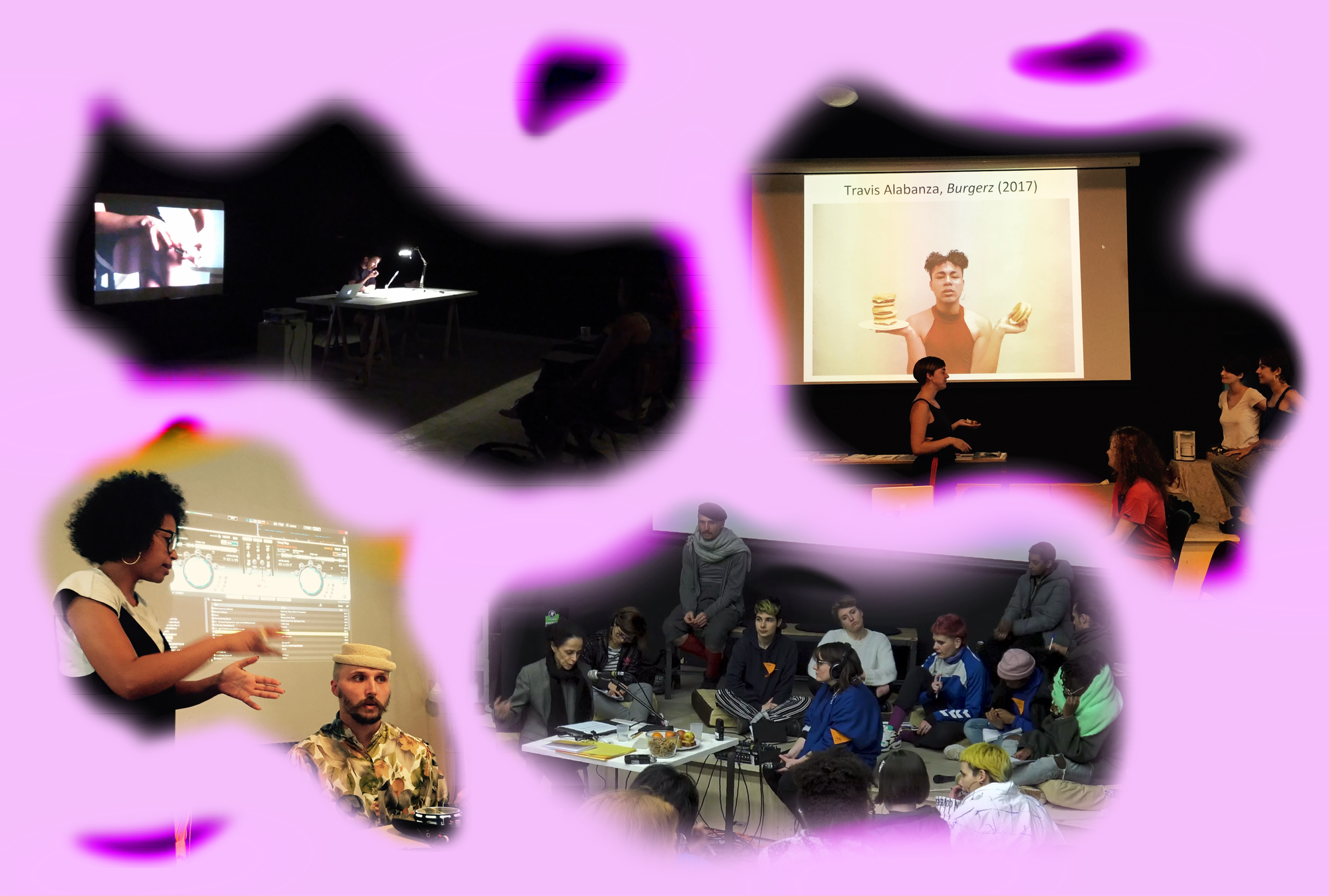
This felt important to me. I have fifteen years of experience in talking about my own pain. While writing an essay about language and pain, it turned into an essay on metaphor. In every word I read about pain—in each memoir, each scientific article, every journal entry—I saw metaphor. Pain and metaphor were all tangled up. Trying to say anything without them made my head hurt—like banging it against a wall. I knew that, for me, metaphor was a technology that I could see myself and other people using to describe, treat, diminish, and manage pain. I felt like this connection might be important to someone else. And I wanted to know if we—the patient, the person in pain—could use it: this thing that I kept turning to when faced with my own pain. To collectively imagine the potential of metaphor in thinking about pain. From July to September 2025, I arranged a series of online and on-site workshops for other people with chronic pain, where we would think, talk, write, and draw to ask: What are medical metaphors all about? Who is making them? And why are we using them?
I announced the workshop series “Our Pain Thinks About Metaphors” online and spread it through my network. Potential participants signed up via an online form, and I scheduled the workshops based on their availability, forming three loose groups. Over the course of the workshop series, 22 people joined me for at least one session, and most made it to all four parts. All attendees identified as having chronic pain, but I did not collect any other demographic data. In the first session, I asked each participant where they were joining from, and although other areas were represented, the majority of us were concentrated in Europe and the United States. Workshops were conducted in English. Many of the participants had some kind of creative practice that they took with them to the workshop space: writing, drawing, crafting, painting. In this essay, direct quotes from the workshops will be italicized. Sometimes these quotes will be short, woven into paragraphs, or tangled together. Longer passages of writing will be credited to their author.
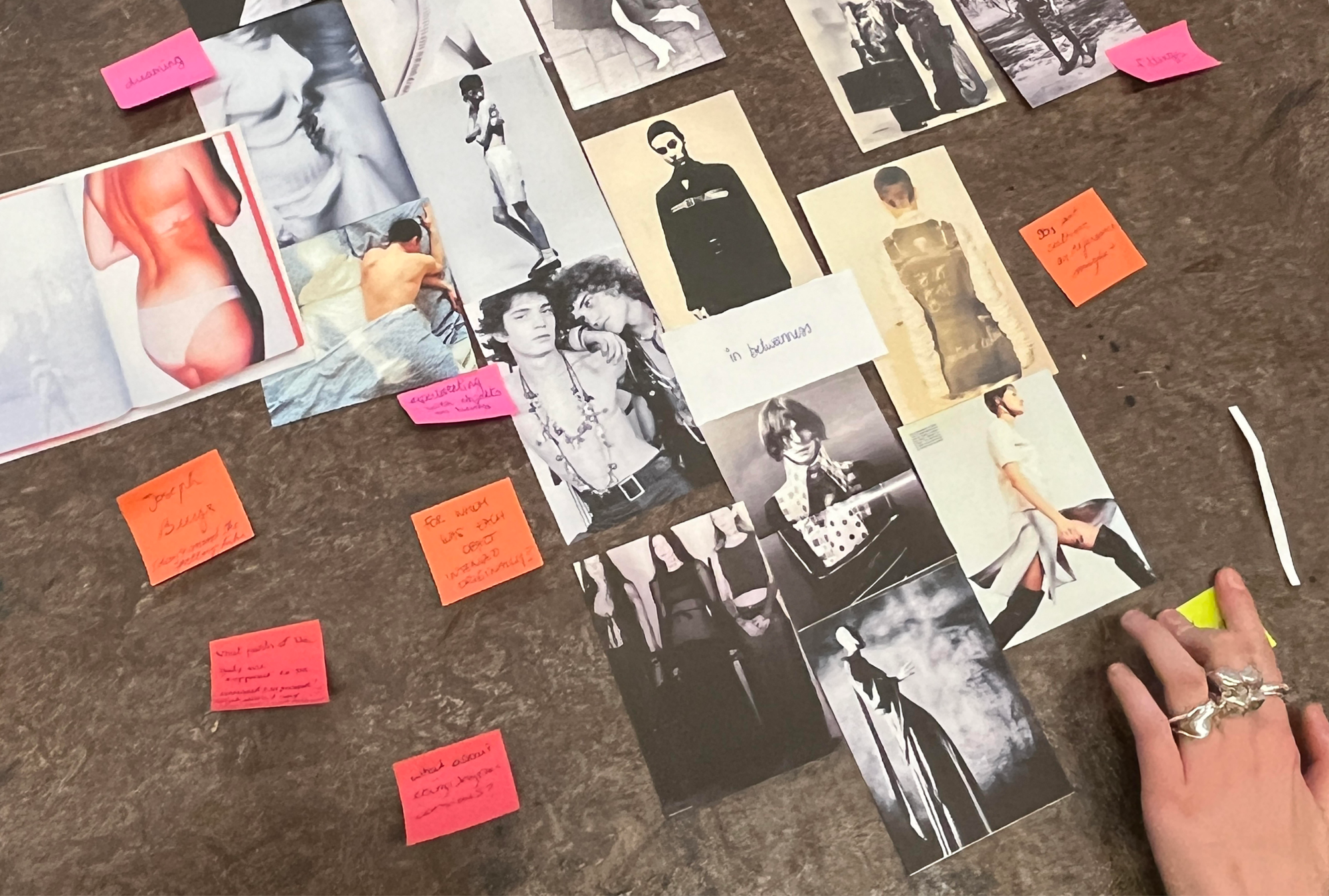
These quotes come from the responses to prompts that I shared, which we thought through individually and together. People wrote, drew, stitched, sat, shared. Sessions One and Two focused on pain and dominant descriptions, while Sessions Three and Four speculated about what might or could be. These workshops were formed in conversation with my research and reading around metaphor—these references were shared in a reading list, along with contributions from participants.
Session 1
Warm-up: Think/write/draw as many words/images as possible to describe your pain.
Prompt 1: Imagine yourself in conversation with a curious alien who knows nothing of your pain. What are you giving/making/describing to them?
Prompt 2: Pick out one image, metaphor, or word. Follow this—what does it tell you/what do you tell it?
Session 2
Warm-up: A (new?) definition for “pain.”
Prompt 1: Write a medical explanation for (your) pain. Pick out one image (e.g. nerves misfiring, etc.) and take this as a starting point for something. You can stay in the “medical” sphere or try and wrangle it outside.
Prompt 2: What is the least mysterious illness you can think of? Describe it (with or without metaphors).
Session 3
Warm-up: Draw (or write) the shape of your pain.
Prompt 1: What came first, the language or the pain, the mind or the pain?
Prompt 2: If metaphor is a vision, what future can you see through yours? What future would you want to see through it?
Session 4
Warm-up: Pick out one example of the classic vocabulary of pain (e.g. stabbing). Try and escape this existing vocabulary: What is a way to describe pain that feels like the opposite of this example?
Prompt 1: In a universe where you know your pain is understood, what metaphor would you choose for yourself?
Prompt 2: Imagine a remote cosmology for your pain to take you to.
(Note to the reader: some of these prompts might make less sense if you don’t have chronic pain yourself. Yet probably—almost surely—you have felt pain, at some time, that you can relate to.)
Let me communicate with you
I was picturing the first time that a caveman stubbed their toe. And I was just imagining them stubbing it and going like “ow, fuck.” And then I was picturing all the other cavemen. Like, they’ve invented this new word. And, so, all the other cavemen are gathering round to learn what this new word means, so they all just start stubbing their toes on purpose, just so that they can say “ow, fuck.”
(Alex’s writing in response to the question: What came first, the language or the pain, the mind or the pain?)
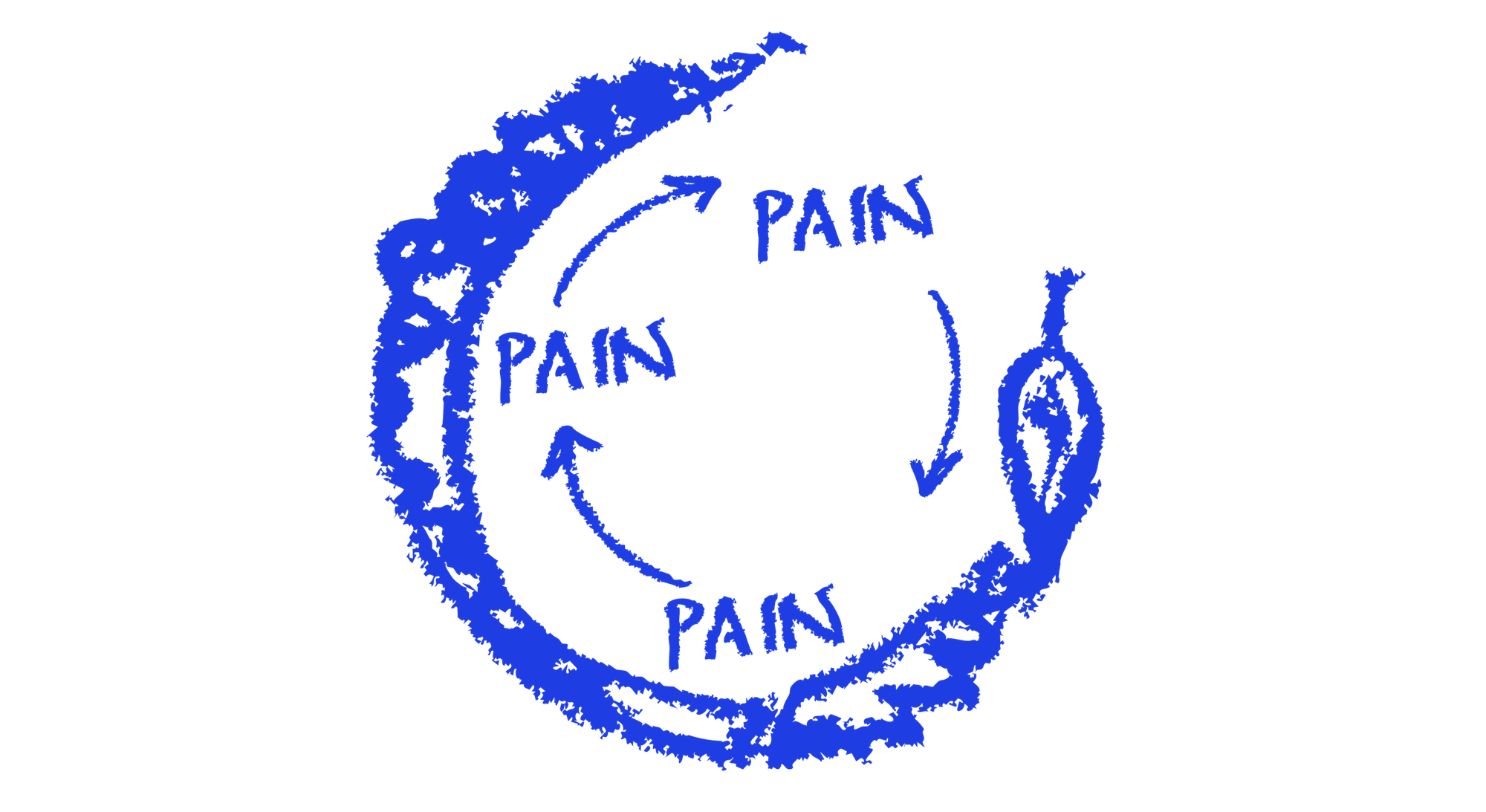
What came first, the language or the pain? Is the pain in my body, or in my head? Can the answer be both? My understanding of this tangle between body, language, and pain follows anthropologist Thomas Csordas, who writes that language is more than simply a representation of the world but is itself a mode of being-in-the-world. It does not describe a world “out there” but is the reason this world exists to us at all. Language, and metaphor, are creative technologies. In our workshops, language came before and after pain. Language and pain came simultaneously and instantaneously. They became a feedback loop. A pain snake chasing its tail around.
So, what did the first caveman who stubbed a toe say? And, did it hurt? Language is also a technology of communication. This is something it has always been: one person reaching out to another, trying to say something. Metaphor is no exception. But we (along with many other animals) also communicate in gesture, in expression, in saying nothing. A lot of research, writing, and artistic thought around pain—particularly chronic pain—has narrowed in on this experience of saying nothing. This question of articulation and explanation came up in our workshops, too. It was just this weird ache that had come over my body, and I just could not articulate it to anybody. Or: when word-finding is impossible because you’re in so much pain, the pain feels more real to me. I’m in a type of pain that isn’t normal. Or: it almost feels like there is no human language because I’ve reverted to an animal. I couldn’t communicate with another person if I wanted to. All there is, is to move through it. Pain is silent, pain is inexpressible, pain is impossible. This, too, is a metaphor. This is also trying to say something.
Pain communicates, too. It is a message. In one workshop, it was described as a bad news pigeon. Pain is flying into your body, trained to send you a letter, no matter what, even if there’s a war outside. Or it is reaching out and knocking on a door in your head. Maybe it is saying “something is wrong.” This is the easy explanation, and it is one that current dominant medical thought agrees with: the function of pain in our bodies is a big, red, stop sign. This metaphor often works quite well for acute pain—for the searing pain of a burnt finger as you pull it out of a fire, for the aching pain of a sprained ankle that requires rest, for the blinding pain of attempting to stand on a broken leg. For chronic pain, or unexplained pain, or otherwise difficult pain, the explanation stumbles. Pain becomes not just inexpressible, not just impossible, but—ultimately—something that is unexplainable.
If the purpose of language is to explain, then, in the case of chronic pain, the technology might have failed. It is in this vein, of failure, that I read this quote from the book The Body in Pain: The Making and Unmaking of the World by literary scholar Elaine Scarry: that “the very temptation to invoke analogies to remote cosmologies […] is itself a sign of pain’s triumph.” But whose failure is it? Who needs the pain explained, really? In many places today, the first place you go when faced with pain is to the doctor. It is to this doctor that we try to explain our pain the most. It is for the doctor that we collect metaphors in our notes app. The doctor has the power of definition. The power to gift us with a shared understanding (or, a diagnosis). So, how is this technology used by them?
Medicalized pain
I’m going to be as vague as possibly possible with you here, and you’re going to have to go and do all of your own reading. And all of your own research, and meet other people with your potential suggested conditions. Don’t forget that word “suggested,” because we still don’t really know what’s going on with you. Come up with your own definition, because actually, we know very, very little about you. We know very, very little about uteruses and ovaries and the likes. Also, when you figure it out, could you come back to me and let me know what you’ve come up with? I’ll probably not listen to you, but it will make me feel good to make you feel bad about your pain.
(India, in response to the prompt “Write a medical explanation for (your) pain”.)
The Western health care system is often reductionist, driven by a desperation for objectivity and for measurement. Pain should be their dream symptom: it is one of the sensory experiences that can be most precisely captured with technological tools. Using brain imaging, scientists can see how pain shows up in the brain, and these signals can be traced and measured. These potential signals of pain, captured by medical technology, can more specifically be called “nociception,” the physiological process of nerve endings being activated by things like heat, pressure, or damage. However, there is a copious amount of evidence that the stimulus does not equal the pain. A great stimulus to your nerve endings does not necessarily lead to great pain, and vice versa. Pain itself is not a physiological process, but a subjective experience.
The International Association for the Study of Pain’s (IASP) 1979 definition of pain goes some way towards acknowledging this subjectivity: they define pain as “an unpleasant sensory and emotional experience associated with, or resembling that associated with, actual or potential tissue damage.” Although there is still a focus on the tissue and the damage, this middle section—“or resembling that associated with”—was an early attempt at cutting through the link between physical damage and the experience of pain. A recent revision to this definition, in 2020, came with a list:
- Pain is always a personal experience that is influenced to varying degrees by biological, psychological, and social factors.
- Pain and nociception are different phenomena. Pain cannot be inferred solely from activity in sensory neurons.
- Through their life experiences, individuals learn the concept of pain.
- A person’s report of an experience as pain should be respected.
- Although pain usually serves an adaptive role, it may have adverse effects on function and social and psychological wellbeing.
- Verbal description is only one of several behaviors to express pain; inability to communicate does not negate the possibility that a human or a nonhuman animal experiences pain.
This slightly wordy definition puts the person in pain, and their experience, at its center. As historian Rob Boddice writes in his article The Politics of Pain, people simply are in pain if they say they are. And people say they are in pain not only verbally, but in actions, in writing, in metaphors. This means that the doctor does not get to check your pain on a scan or in a blood test. Instead, they have to listen.
Taking my metaphors to the doctor
It’s like a stethoscope threaded through a fat tube. It’s like a bright box with sparse shelves and sharp tools hidden away. It’s like 6 years of education versus 13 years of training.
The doctors are trying to figure out what’s wrong with you, and they end up just licking it. Like, licking the pain, because they’ve run out of ideas on how to work out what the hell is going on.
(Two responses to the same prompt: “Write a medical explanation for (your) pain.” The first was written by Matt, the second by Alex.)
In her book Illness as Metaphor, writer and critic Susan Sontag concludes that illness should be “purified of” metaphoric thinking. In Sontag’s work, metaphor is linked to mystery. She suggests that it is those mysterious, misunderstood illnesses—such as cancer, which she had at the time of her writing—that leave us reaching for metaphor. Today, pain, especially chronic pain, remains particularly mysterious. This is perhaps why the IASP definition has become quite so unwieldy. In searching for definition and explanation, pain becomes an emotion to account for the fact that it can’t be measured (scientifically) or completely understood. Medicine’s central premise, or promise, is that disease can be cured. “Pain is personal,” “pain is inexpressible,” “pain is unexplainable.” This impulse, as one workshop participant highlighted, to call pain inexpressible or impossible, tries to absolve medicine of its failures.
Psychologist Raymond W. Gibbs, whose work focused on metaphor and bodily experience, suggested that medicine has often shown a suspicion of metaphor, as the opposite of objective truth. However, there are many examples of medicine mixing with metaphor, ranging from the use of explanatory metaphors in textbooks to medical students to metaphor-led psychotherapy. This includes work that takes metaphor seriously, within diagnosis or treatment, and as a way to change thought patterns. It also includes the metaphors that doctors use, perhaps less critically, to explain pain to themselves and to their patients—like the terms “stabbing” or “burning” pain. Through each workshop session, I collected descriptions and explanations used in medical settings for our pain. Nearly every one was a metaphor:
Alarm systems going off
A problem with your software, not your hardware
Software malfunctioning
Gate control theory
A war within the body
Healing as a journey
Pain is not the only sickness that leaves us reaching for metaphor. Metaphor is entrenched in science. In our understanding of the body. Pain is the mysteries of my beautiful corporeal slop. A bottomless pit of mystery. Mystery all the way down. As essayist and journalist Ellen Willis aptly acknowledges in her critique of Sontag, “The allopathic medical model of disease, as an entity entirely external to the person, with an objective cause and cure, is as metaphorical as any other.”
Treating metaphor as a linguistic flourish with no place in “scientific” thought is to overlook its pervasive use in medicine. It also allows us to overlook the significance of these metaphors and how they function. To fully understand these aspects of metaphor, it can instead be understood as a medical technology—applied to measure, assess, and control pain and the patient.
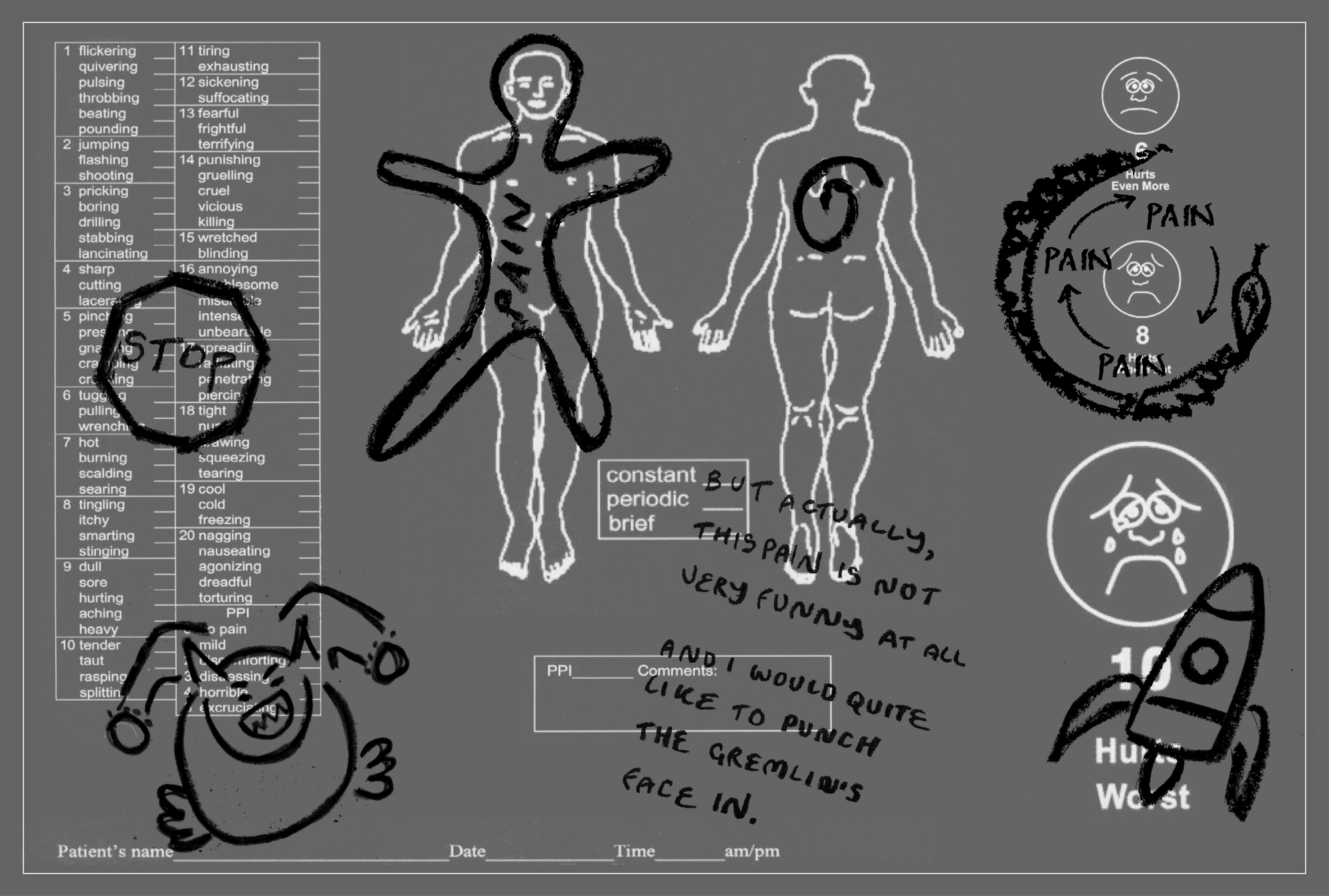
The function of metaphor as a medical technology becomes especially clear in the McGill Pain Questionnaire (MPQ), which is employed to measure pain and relies heavily on metaphoric descriptions. It consists of a list with 78 graded verbs and adjectives that the patient is asked to mark if they apply, along with questions concerning location, strength and temporality. An analysis by linguist Elena Semino suggested that at least one third of the descriptors are linked to metaphors of damage (for example, stabbing, tearing, or crushing), while others link pain to extreme temperatures (for example, freezing and burning) or a “malevolent animate agent” (for example, annoying, punishing, or torturing). These metaphors are almost entirely negative.
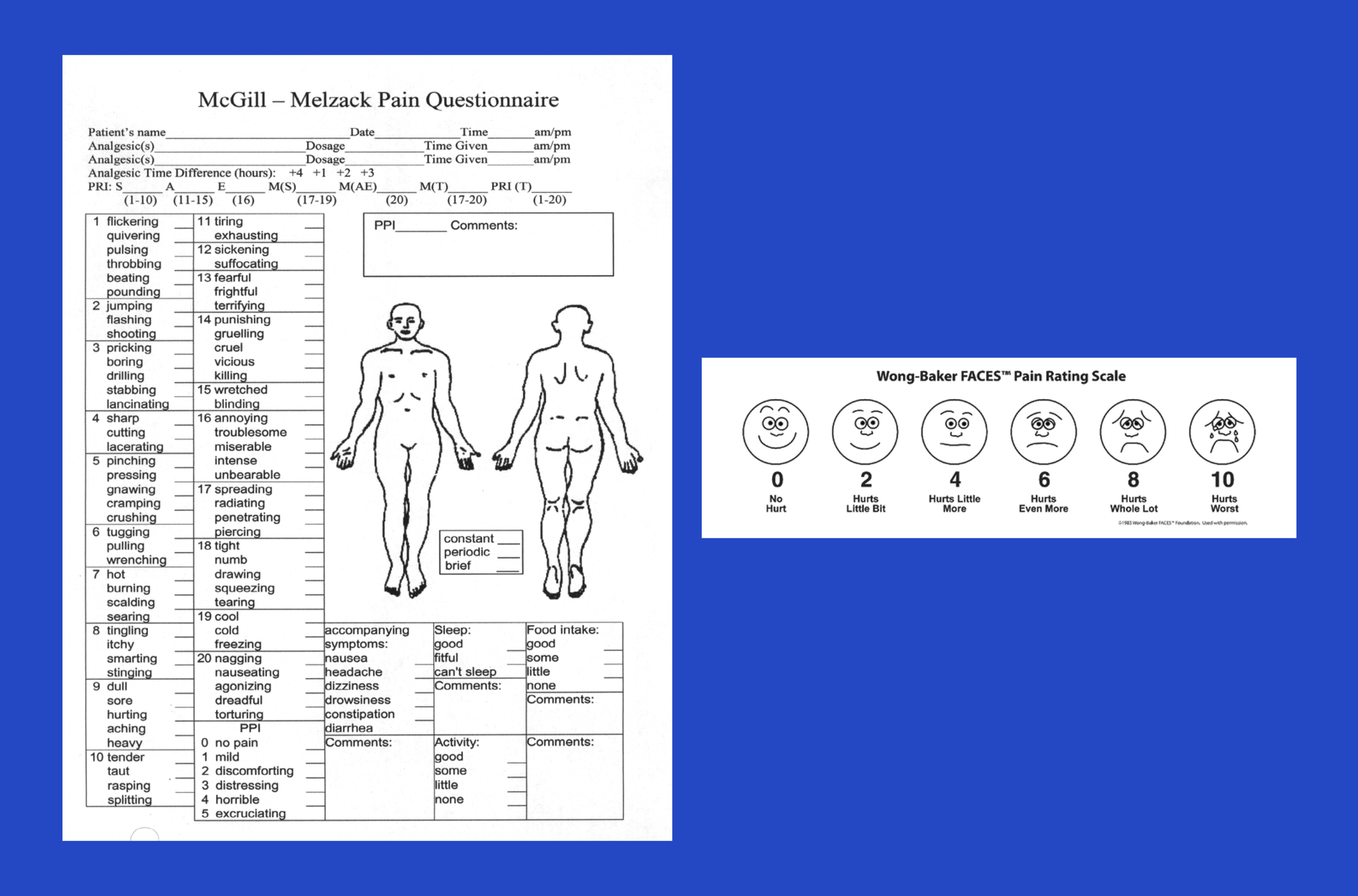
The Wong-Baker FACES Pain Rating Scale, another medical technology of measurement, presents the patient with images of six faces, with expressions ranging from a large smile to crying. Beneath these faces are numbers, zero to ten. Zero is no pain, ten is the worst. These faces act as metaphors, too. Each face conveys a different level of pain: a smile stands for less pain, tears for more. These are images that stand in for the experience of pain, one thing being used to describe another. “Pain behaviors” (a term used to describe how our bodies act when in pain) are used to assess pain. Pain is crying, pain in the leg is limping, pain in your hand is cradling. Each movement is taken as meaning: pain behaviors act as metaphors for the experience of pain.
Another medical use of metaphor can be found in diagnosis, the use of a collection of signs and symptoms to assign patients to an illness narrative. Like many of the participants in my workshops, my pain is not medically unexplained. There is something wrong with my nervous system. My diagnosis of Complex Regional Pain Syndrome (CRPS) means that nerves light up at the wrong time: touch means pain, temperature means pain, pressure means pain. These, too, are metaphors. The diagnosis (CRPS is the collection of symptoms being described); the definition it provides (pain is nerves lighting up at the wrong time); and the cause (touch, temperature, pressure is pain). Other diagnoses come with their own metaphors.
“Particularly for those in marginalized communities, pain is frequently dismissed, undertreated, and misdiagnosed.”
So, perhaps medicine isn’t scared of metaphor at all. Maybe our dominant medical systems just want us to use theirs. But none of these metaphors—not the McGill Pain Questionnaire, nor the FACES Pain Rating Scale, nor any similar method—work particularly well for grasping chronic pain. We do not use the same pain behaviors as someone in acute pain. Crying, limping, or screaming all get tiring after a while. We train ourselves out of it, or are trained out of it by pain clinics and physios. The metaphors the doctor hands us in their diagnoses and explanations often do not answer the key question: Why me, and how can I survive it? So, we try to find new ones. New ways to express our pain, that a doctor might cling on to and then reward with more understanding, more treatment, more care.
The struggle to be believed is a consistent feature in writing on and around pain. Particularly for those in marginalized communities, pain is frequently dismissed, undertreated, and misdiagnosed. We are treated as unreliable narrators of our own pain narratives, not because pain is not expressed, but because it is not believed. Our metaphors are not working quite right. Somewhere, the technology is broken. Or, of course, the technology was never made to work for us.
Metaphors of the future
The fact that current medical metaphors are often not helpful does not necessarily mean we should be done with them. Instead, we could reformulate metaphor as a technology that works for us. In one of our early sessions, one participant asked: “What are the practices of making metaphor that aren’t imposing?” In a later session, I asked: “What metaphors would you use if you did not need to explain your pain?”
This was a speculative world. One that could be a struggle to imagine. If everyone understands me, why do I need metaphor? one participant responded to my prompt. Another: I tried to come up with a metaphor for myself, but it was too hard. It was too unbounded, too hard to imagine. Without the urge for explanation, metaphor became boundless. They could, instead, be used to complicate things. To try to describe something that does not exist at all. Like a crazy new material that our world has never seen and cannot imagine. In this world where pain was understood, metaphor was a detour that could lead to misinterpretation. Yet, there is something juicy in the unexplainable. In the attempt to show just how weird and unworldly something is. Cells bursting and unmaking themselves inside the bag of your skin and turning into a congealed ooze that seeps everywhere. Or adding a weird growth to a needlework petri dish. These metaphors are medical, but they won’t be found in the doctor’s office. Instead, they are just for us.
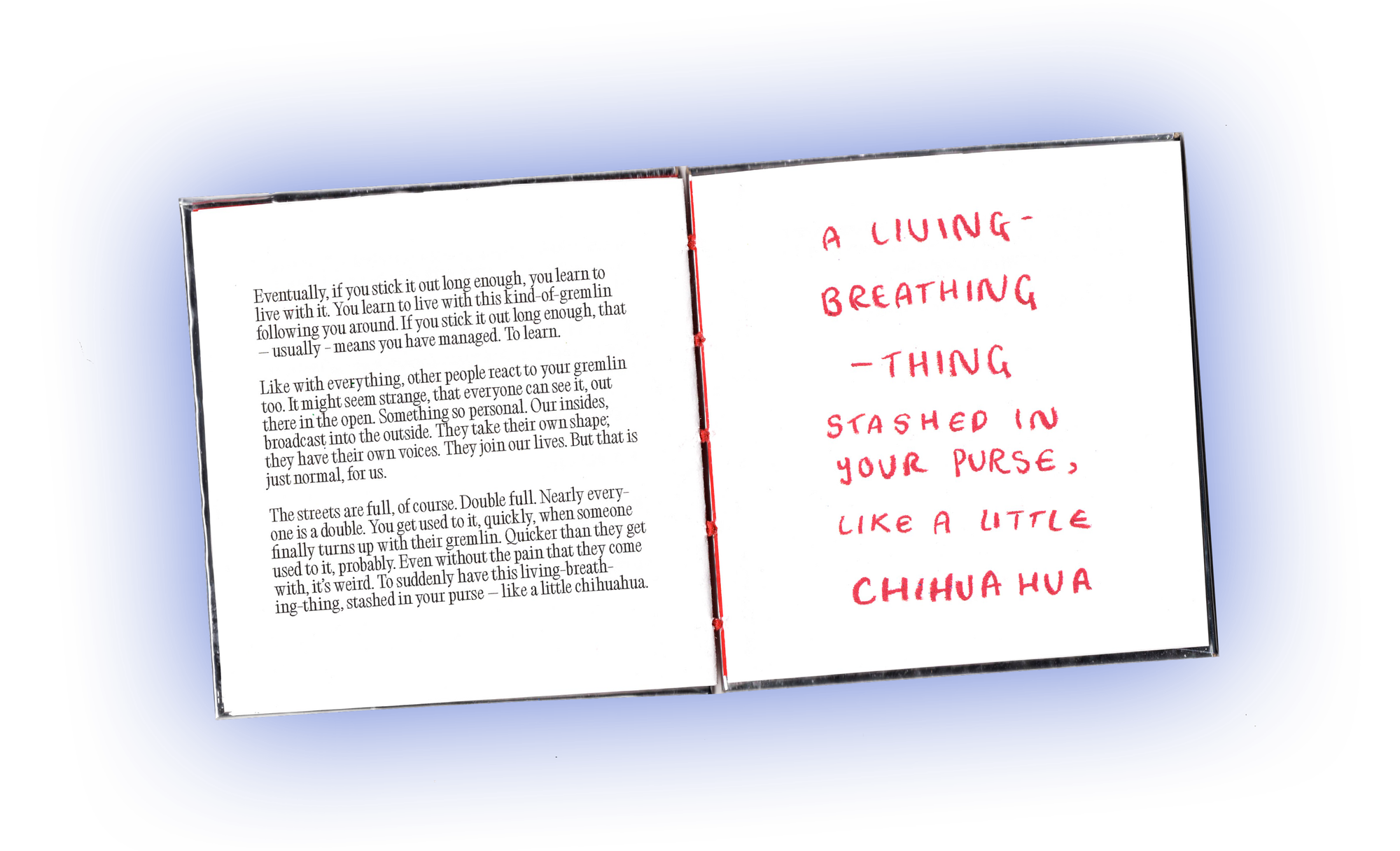
In our collective metaphors, pain came down to Earth while flying into space. It became a gremlin, a standing log, an alien, a toddler poking your side until you pay attention, a really nice bed, a cratered moon. Pain started to use “I statements” from a therapist’s couch. Roiling. Stirred up sediment that never quite settles. It became a rift opening and closing between muscle fibers and skin cells and blood vessels and nerves. Groundwater swelling up through soft mud, knitted together with weeds. It became something you learn to live with. Sometimes the earth appears dry, but just below the surface, the wet knots and tangles strain, keeping your feet from sinking in. Interconnected like air and gravity and movement, reaching out of the body and mingling with other breath, other pain, other healing. Fluctuating and sure to return. Connecting our body to an other body.
Our imagined futures rarely meant a future with no pain or disability (an ableist future that is often described in popular speculative fiction). Instead, in this new world, we could embrace language, and metaphor, as a new kind of technology. One that does not promise complete understanding. It does not promise a cure. Instead, language became a way of coming closer to what it is, without the expectation that there is a way of understanding completely. Where this technology no longer had to reach only towards the intelligible. Inexpressible and unexplainable are not synonyms. Metaphor, instead, became a technology to bring something into being.
I was thinking through what pain and disability could look like, beyond the sort of world we live in now, and shaping visions for a disabled future. Like, there’s a storm. What does it mean to weather that with other people, and to honor the things that shape our lives, and recognize the natural parts of human variation? But then also chip away at all of the terrible and unjust things that create pain. And I was thinking about ecosystems of care and how people reach out to each other and connect across pain experiences or disability, and all the things that, as people, we owe each other. How do we work to put these things together? I don’t know—nature does so much to sustain itself, even while it’s being actively ravaged. What does it mean to tend to an ecosystem that is going to exist, whether or not we act upon it?
(Katie, imagining a remote cosmology for her pain to take her to)
Lindsey Allen (she/they) is a researcher, writer, and designer based in Bristol, UK. She writes in the intersections of care, time, disability, and the environment, with a focus on creative non-fiction and the essay form. She has been published in Sick Magazine and through Sticky Fingers Publishing, as well as through various online publications. In her broader creative practice, she creates socially engaged, often participatory work, utilizing facilitation and creative workshops that focus on employing caring methodologies. All her work is grounded in anthropological methods, aiming to explore how people understand the world they live in, and their hopes and imaginaries around how this world could be.
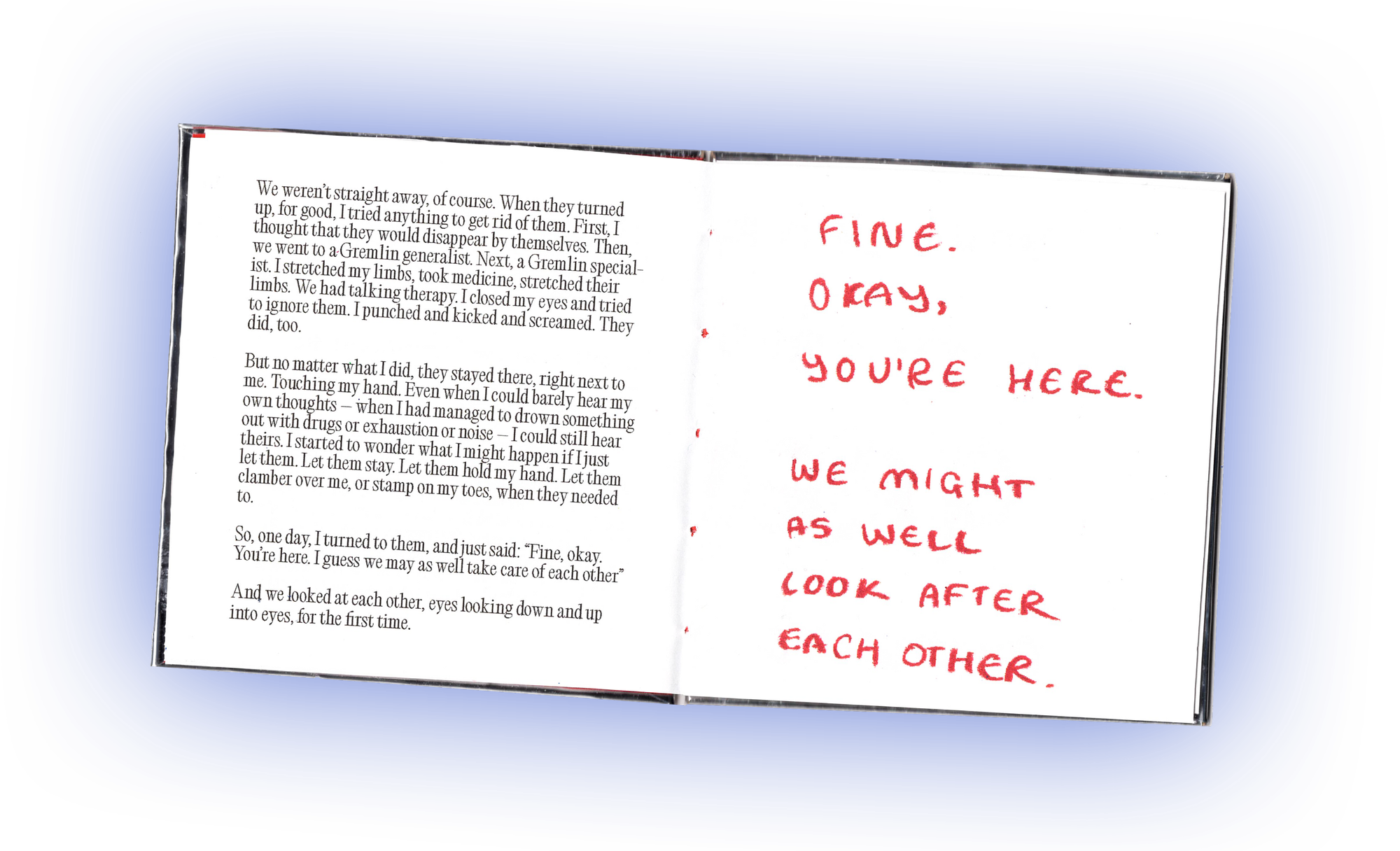
The Gremlin Nation zine is a strange world, full of strange beings. The residents of Gremlin Nation do not just feel pain, they also bring something into being from it. The streets are double full. The people, and then the gremlins attached to them. This report, written by one woman and her gremlin, living in this place far away from Earth, was created as a memorial to this world—to share a little about who lived here, for those who come next. This piece of speculative fiction explores just one shared metaphor from the workshops—the metaphor of pain as a gremlin—to imagine a world in which this metaphor was really brought to life.
The text and zine were produced as part of the Unwired Currents—Imagining Technologies Otherwise fellowship under the mentorship of Iyo Bisseck and Mio Kojima.
The fellowship was part of the Unwired Currents—Imagining Technology Otherwise larger collaborative project between Dezentrum and Futuress, along with Dreaming Beyond AI, Franca López Barbera, and Matería Oscura. The program was possible thanks to a generous grant from the Swiss Arts Council Pro Helvetia.
Books
- Illness as Metaphor – Susan Sontag
- The Body in Pain – Elaine Scarry
- Metaphors we live by – George Lakoff and Mark Johnson
- Inside Chronic Pain: An Intimate and Critical Account – Lous Heshusius
- The Undying – Anne Boyer
- A Matter of Appearance – Emily Wells
- The Body is a Doorway – Sophie Strand
- Explaining Humans – Camilla Pang
- Parable of the Sower – Octavia Butler
- Turn Illness into a Weapon: For agitation – Socialist Patients’ Collective
- Beauty is a Verb: The New Poetry of Disability – Sheila Black, Jennifer Bartlett, Michael Northen (Ed.)
- Stairs and Whispers: D/Deaf and Disabled Poets Write Back – Sandra Alland, Khairani Barokka, Daniel Sluman (Ed.)
- Versus Versus: 100 Poems by Deaf, Disabled & Neurodivergent Poets – Rachael Boast (Ed.)
- Pain as metaphor: metaphor and medicine – Shane Neilson
- Perspectives on the insidious nature of pain metaphor: we literally need to change our metaphors – Mark Johnson, Matt Hudson, Cormac G Ryan
- Acute pain is sexy and chronic pain is not: representations, language and transformation – Jennifer Patterson
- Space and Embodied Experience: Rethinking the Body in Pain – Marja-Liisa Honkasalo
- How metaphors shape the particularities of illness and healing experiences – Raymond W. Gibbs (Jr)
- The message in the bottle: Illness and the micropolitics of resistance – Nancy Scheper-Hughes and Margaret Lock
- The politics of pain – Rob Boddice
- Interview with Ocean Vuong
- Fantastic Voyage
- Star Trek: The Next Generation – Darmok
- That’s so Raven
- Horrible Histories
- Detective Pikachu